

If your case was denied, you missed court, or something has changed, a properly built Motion to Reopen can put you back in front of a judge. The problem: most motions fail. Not because the person did not qualify, but because the motion was built incorrectly. Working with an experienced immigration motion to reopen attorney in New York ensures your motion is drafted with precision.
Reviewed by Hon. Raisa Cohen (Ret.). Retired U.S. Immigration Judge. Former DHS/ICE Assistant Chief Counsel. New York Immigration Attorney.
Most people who walk into my office after a denial waited too long. They hoped. They asked around. They lost time. By the time they reach me, half their options are gone. The other half are still on the table, but only if we move fast and build the motion the right way.
“I reviewed hundreds of Motions to Reopen from the bench. Most were denied. Not because the case was weak, but because the motion was rushed, vague, or legally incomplete.” (Hon. Raisa Cohen, Ret.)
Do not guess. Do not wait. Book a consultation and get a clear answer this week.

DEFINITION. Motion to Reopen: A legal request asking an Immigration Court or the Board of Immigration Appeals to review new facts that were not available at the original hearing and could change the outcome of your case.
This is not an appeal.
If the motion is granted: your prior removal order is vacated, your case is reopened, and you get another chance to apply for relief. For many people, this is their only second chance. When you consult a dedicated motion to reopen immigration case lawyer in New York, we evaluate your new evidence to see if it meets these criteria.
These three procedural tools sound similar and they all challenge a prior decision, but they are not the same. If you are evaluating a motion to reconsider in immigration in New York, filing the wrong type of motion wastes the only opportunity you may be entitled to.
|
Question |
Motion to Reopen |
Appeal |
Motion to Reconsider |
|
What is it for? |
New facts or evidence that change the case |
Argues the judge made a legal or procedural error |
Argues the judge applied the wrong law to the facts already in the record |
|
Where filed? |
With the IJ or BIA, depending on which issued the order |
With the BIA (from IJ); or AAO/BIA from a USCIS decision |
With the same body that issued the prior decision |
|
Deadline? |
90 days standard. 180 days for in absentia (exceptional circumstances). No deadline for lack of notice or changed country conditions in asylum cases. |
Generally 30 days from the IJ order to the BIA |
Generally 30 days from the prior decision (33 if mailed, depending on type) |
|
Number allowed? |
Generally one, with statutory exceptions |
One |
Generally one |
|
New evidence? |
Required |
Not allowed (record-based) |
Not allowed (record-based) |
Not sure if you qualify? We will tell you in the consultation. Book a session.
Be honest with yourself before you spend money on a consultation. A Motion to Reopen is not for someone who simply disagrees with the judge’s decision. That is what an appeal is for, and the appeal deadline is 30 days from the order.
It is also not a way to delay removal. Filing a frivolous motion can hurt your credibility with the court and waste the only motion you may be entitled to. The system generally allows one motion to reopen. Exceptions exist, but they are narrow.
This is where most cases fail before we even get a hearing. Miss the deadline and the court will not look at the merits. Period. Consulting a knowledgeable reopen deportation case lawyer in New York early in the process is critical to avoiding missed windows.
From the date the Immigration Judge or the BIA issued the final order in your case. Counted in calendar days, not business days. (See INA § 240(c)(7); 8 C.F.R. §§ 1003.2, 1003.23.)
If you missed your hearing because of exceptional circumstances (serious illness, death of an immediate family member, a documented emergency beyond your control), you have 180 days from the order to file. (INA § 240(b)(5)(C)(i).)
If you never received proper notice of the hearing, there is no time limit. We have successfully reopened orders that were a decade or more old by proving defective service. (INA § 240(b)(5)(C)(ii).)
For asylum, withholding, and Convention Against Torture cases, you can file outside the 90-day window if you can document that conditions in your country have materially worsened since your last hearing. The evidence has to be specific: a country conditions expert report, current State Department reporting, news coverage, affidavits.
If DHS counsel agrees to the motion, you are not bound by the 90-day rule or the one-motion limit. These motions are uncommon. They require a clear legal basis and a working relationship with the government attorney handling your case.
Once the 90-day deadline passes, even strong cases are often permanently barred. If you are unsure which deadline applies to you, call us today.
Book a consultation now, before your window closes. (718) 865-2317
Short answer: If the standard deadlines have run, three narrow doctrines sometimes provide a path forward: (1) sua sponte reopening, where the BIA or an Immigration Judge reopens a case on its own motion in exceptional situations; (2) equitable tolling, recognized by federal courts in narrow circumstances when an applicant exercised due diligence and was prevented from filing by extraordinary circumstances; and (3) class-action settlements that create separate procedural rights, such as the Calderon settlement covered below. None of these is a guaranteed path. Each requires the right facts and the right legal framing. We evaluate them only when the standard motion is no longer available.
Under 8 C.F.R. § 1003.2(a) for the Board of Immigration Appeals and 8 C.F.R. § 1003.23(b)(1) for Immigration Judges, the adjudicator has discretionary authority to reopen a case on its own motion. The BIA has long held that this authority is reserved for exceptional situations. Recent case law has narrowed the doctrine, and sua sponte motions are now harder to win than they once were. They are not impossible. They require a compelling fact pattern, a careful brief, and realistic expectations.
Federal courts have recognized that the deadlines for filing a Motion to Reopen are subject to equitable tolling in narrow circumstances. The U.S. Supreme Court confirmed in Mata v. Lynch, 576 U.S. 143 (2015), that federal courts have jurisdiction to review denials of motions to reopen, including where the petitioner argues that the deadline should be tolled. Standards for equitable tolling vary by circuit, but typically require the petitioner to show: (1) extraordinary circumstances that prevented timely filing, and (2) reasonable diligence. In the Second Circuit (which covers New York), see, e.g., Iavorski v. INS, 232 F.3d 124 (2d Cir. 2000).
These are not promises. Sua sponte and equitable tolling are doctrines of last resort. They sometimes work for the right facts. They are never to be assumed. The honest answer is: bring the case to a consultation and we will tell you whether the path exists.
Past the deadline? It may not be over. Book a consultation.

Short answer: Calderon Jimenez et al. v. Noem et al., No. 1:18-cv-10225-PBS (D. Mass.), produced a class settlement approved by the federal district court on January 16, 2025. Class members are individuals married to U.S. citizens who have a final removal order, are the beneficiary of a pending or approved I-130, are 17 or older, and reside or are detained within the Boston ICE ERO jurisdiction. That jurisdiction covers the six New England states: Massachusetts, Rhode Island, Connecticut, Vermont, New Hampshire, and Maine. Under the settlement, ICE OPLA must presumptively join a Joint Motion to Reopen and Dismiss (JMTR) the class member’s removal proceedings, with narrow exceptions for public safety, national security, serious immigration benefit fraud, or repeat immigration violations.
This is one of the more powerful settlements to come out of immigration litigation in recent years. For people with old final removal orders who are otherwise eligible to adjust through their U.S. citizen spouse, Calderon turns what looked like a closed case into a genuine second chance.
Short answer: If ICE OPLA agrees the class member meets the criteria, ICE files a Joint Motion to Reopen and Dismiss with the Immigration Court or BIA. If granted, the prior removal order is vacated and proceedings are dismissed. The class member can then move forward with adjustment of status or consular processing through Form I-601A. ICE also may not remove a class member while the JMTR is pending, per the federal district court’s enforcement of the settlement.
The JMTR packet is submitted to ICE OPLA through the dedicated Calderon submission process established under the settlement. There is no filing fee. We handle the submission, the OPLA communications, and the follow-through with the Immigration Court or BIA once the joint motion is filed.
Short answer: The Calderon settlement runs for two years from the January 16, 2025 approval. Class members must submit JMTR requests by 11:59 p.m. on January 16, 2027. The two-year window is firm. Class counsel has emphasized: do not wait until the last moment. OPLA review averages two to five months, and a denial may require corrections and resubmission.
Cohen Immigration Law Group is based in Forest Hills, New York. The Calderon settlement covers residents and detainees in the six New England states (Massachusetts, Rhode Island, Connecticut, Vermont, New Hampshire, and Maine), not New York. Three points worth knowing:
Calderon is one tool. Sua sponte is another. Equitable tolling is another. Joint Motions to Reopen with DHS are another. Changed country conditions are another. The right second chance depends on your facts. The right attorney finds it.
Married to a U.S. citizen with a final removal order? Book a consultation to evaluate Calderon and other paths.
Short answer: Sometimes yes. The 90-day deadline is firm for most Motions to Reopen, but two important exceptions allow filings years later: lack of notice (no deadline) and changed country conditions in asylum cases (no deadline). We have reopened orders more than a decade old when defective service or new country evidence supported the motion.
If you have a removal order from years ago, do not assume your case is over. Bring everything you have to the consultation: the original Notice to Appear, any prior briefs, every change-of-address form you ever submitted, current country conditions evidence, and any relief that became available later (marriage, U visa certification, TPS grant, an approved I-130). We pull the record, check the service file, and tell you whether a path still exists.
Short answer: If you missed an immigration court hearing, an in absentia removal order may have been entered against you. You can ask the court to rescind that order through a Motion to Reopen. The deadline depends on why you missed: 180 days for exceptional circumstances (serious illness, family emergency, documented event beyond your control); no deadline if you never received proper notice. Filing the motion can also create an automatic stay of removal in limited situations, including in absentia motions based on lack of notice.
Practical tip: do not wait to confirm whether you actually have an order. Check your status on the EOIR Automated Case Information system, or ask us to pull the file. The longer you wait, the harder it is to recover documents and witnesses.
Short answer: Asylum cases can be reopened on the same statutory grounds as any other immigration case (lack of notice, exceptional circumstances, ineffective assistance, new evidence), and asylum cases also have a special path: changed country conditions. Under INA § 240(c)(7)(C)(ii), there is no time or number limit on a Motion to Reopen filed to apply for asylum, withholding, or CAT relief based on changed country conditions arising in the country of nationality or removal.
Changed country conditions motions require specific, current evidence. A general statement that things ‘got worse’ will not move the court. We build these motions with country conditions expert reports, contemporaneous human rights reporting, State Department documents, and affidavits tailored to the petitioner’s individual risk profile.
Short answer: Ineffective assistance of counsel is a recognized basis for a Motion to Reopen when a prior attorney’s serious errors caused the adverse outcome. The BIA established the procedural framework in Matter of Lozada, 19 I&N Dec. 637 (BIA 1988). Lozada requires the petitioner to (1) submit an affidavit setting forth the agreement with prior counsel and what was promised, (2) inform the prior attorney of the allegations and give them an opportunity to respond, and (3) report the prior attorney to the appropriate disciplinary authority (or explain why not).
Lozada compliance is not optional. We have seen otherwise strong ineffective assistance claims denied because the petitioner skipped one of these steps. We handle the entire Lozada procedure as part of the motion.
Most Motions to Reopen fail. Not because the person did not deserve relief, but because the evidence was weak, the legal theory was wrong, or the motion was filed too late. This is not a form. This is strategy.
There is a filing fee currently set by EOIR for a Motion to Reopen. (Confirm the exact figure on the EOIR fee schedule before filing. Federal fees changed in 2024 and again in 2025.) A fee waiver is available for clients who cannot afford to pay; we file Form EOIR-26A when appropriate.
There is no filing fee for a Motion to Reopen an in absentia order based on lack of notice.
Attorney fees for a Motion to Reopen vary based on complexity, the legal basis, the volume of evidence, and whether we are filing before the Immigration Court or the BIA. We quote a flat fee at the end of your consultation, in writing, with payment plans available.
Filing forms is the easy part. Building a winning strategy is where most cases fail. Here is the process when you retain us:
Hearing transcript, prior filings, the Notice to Appear, every prior brief, the judge’s decision. If you do not have it, we file a FOIA. We do not draft until we know exactly what was in front of the prior judge and what was missing.
There is rarely just one ground. Lack of notice plus changed country conditions plus new evidence may all apply. We pick the strongest and brief it. We plead the others in the alternative so the court has more than one path to grant the motion.
Affidavits from you and witnesses. Country conditions reports from credible experts. Medical records, police reports, ID documents, prior counsel’s case file. Everything is indexed, paginated, and authenticated.
This is the part most pro se filings miss. The court will not reopen a case just because you have new facts. You have to show the new facts make you eligible for relief (asylum, cancellation, adjustment, withholding) that you were not eligible for before. We brief that explicitly.
In some categories, the stay is automatic. In most, it is not. If ICE could detain or remove you while the motion is pending, we file a separate stay request and follow up. We do not file and wait.
If granted: we move directly to merits prep. If denied: we evaluate appeal to the BIA or, where appropriate, federal court review. The motion is not the end of the strategy. It is the beginning.
Want this built right? Book a Strategy Consultation.
Most immigration attorneys have never sat on the other side of the bench. Raisa has. Raisa Cohen read motions from both directions for years. She knows what makes a judge grant one, and what makes a judge deny one in the first paragraph.
Here is what I saw, again and again:
That bench-side perspective is the difference between a motion that gets read and a motion that gets granted.
A client came to us with a 15-year-old in absentia removal order. She had built a life here: children, a home, a job, no criminal record. She believed her case was over.
It was not. The original hearing notice had been sent to an address she had not lived at for years. She had submitted a change-of-address form to the court that the court never processed. The government had never properly served her.
We pulled the record, documented the defective service, filed the Motion to Reopen, and the prior order was vacated. Her case is back in court with active relief on the table.
This is what a properly built motion looks like. It is not magic. It is documentation, legal framing, and a working knowledge of how the court actually decides these cases.
90 days from the final order in most cases. 180 days if you missed an in absentia hearing because of exceptional circumstances. No deadline if you can prove you never received notice. If you do not know which one applies to you, call today. We will tell you in the consultation.
Not automatically in most cases. There are limited situations where filing creates an automatic stay, including in absentia motions based on lack of notice. In every other category we typically file a separate request for a stay of removal. Do not assume filing protects you. Talk to a lawyer the same week.
Generally no. The statute allows one. Exceptions exist for changed country conditions in asylum cases, joint motions agreed to by DHS, and certain humanitarian situations. We evaluate this in the consultation before you spend money on a second filing that the court will likely reject.
A criminal record does not bar a Motion to Reopen, but it changes what relief is available to you and how the court will view discretion. We need the certified disposition of every charge to evaluate the case. Bring everything you have, including arrests that did not result in convictions.
Yes. Ineffective assistance of counsel is a recognized basis under Matter of Lozada (BIA 1988). The BIA requires specific procedural steps before that claim will be heard, including notice to the prior attorney and a bar complaint where appropriate. We handle that procedure as part of the motion.
It varies. Some motions are decided in two to three months. Others sit for six months to a year, especially before the BIA. Filing a properly briefed motion with a complete record helps. Filing a thin motion that requires the court to ask follow-up questions slows it down.
Your prior order is vacated. Your case is reopened. You get a new hearing on the merits, and that is when we apply for the relief that the new facts now make available.
You may have appeal rights to the BIA or, in narrow circumstances, federal court review. We evaluate that the same week the denial comes in. A denial is not always the end.
Not for the consultation. We do paid consultations by Zoom and by phone. If you retain us, most of the work (document collection, drafting, filings) is done remotely. We see clients in the Forest Hills office for in-person strategy meetings when needed.
You can. Most pro se motions are denied. The procedural and evidentiary requirements are unforgiving and the BIA does not help you fix mistakes after filing. If your case matters to you, do not file the motion alone.
Still have questions? Book a Strategy Consultation. (718) 865-2317
Most firms offer free consultations that lead nowhere. This is a paid strategy session where you leave with a real legal plan.
Current consultation fee is confirmed when you book.
Most of our clients use payment plans. The strategy session gets you the answer to whether the case is even worth pursuing, before you spend anything else. Sometimes that consultation saves you thousands by telling you not to file.
Your removal order has already drawn attention. ICE has your file. The question is not whether to be visible. It is whether to be visible with a lawyer who knows the system, or visible alone.
A common reason clients come to us. If your prior attorney made errors, that may itself be a basis for the motion (see Lozada above). Bring everything you have (the file, the bills, the emails) and we will evaluate it in the consultation.
Two things. One, the bench experience: I read motions to reopen for years from the other side. Two, the prosecutor experience: I worked as Assistant Chief Counsel for the government before I was a judge. I know how DHS argues these cases. That is the perspective most defense attorneys do not have.
Because in most cases, you do not get a second chance. The court reads the motion once. The legal theory either holds or it does not. The evidence either supports the theory or it does not. The deadline either lets us in the door or it shuts it for good.
“I had a phenomenal experience with Attorney Raisa Cohen. I was facing removal proceedings and didn’t know where to turn. My prior attorney was disbarred, and I went to Attorney Raisa Cohen for help. She took on my case and fought hard for me.” (Rosemary)
“I had the pleasure of speaking with Raisa Cohen, and she provided me with clear and valuable legal guidance. She patiently clarified important points, laid out a clear roadmap for me, and summarized everything in a way that was easy to understand.” (Sayed)
“Raisa Cohen is a fantastic immigration lawyer. Her knowledge as a former immigration judge truly helped me out in my situation and I would highly recommend her services.” (Anonymous, Avvo)
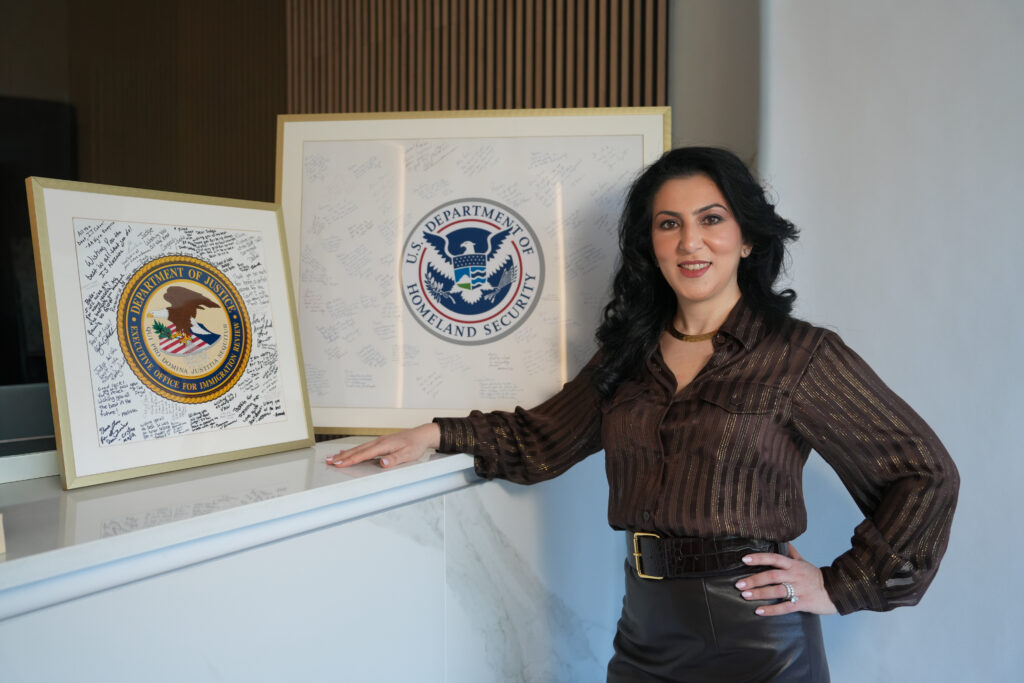
If you are searching for a New York Motion to Reopen or Removal Defense Appeals lawyer near you, contact Cohen Immigration Law Group, P.C. for a consultation. Raisa Cohen is an experienced U.S. Immigration Judge and former ICE prosecutor who is committed to helping you get through this troubling time. Contact us today for a consultation.